 Ben Boss
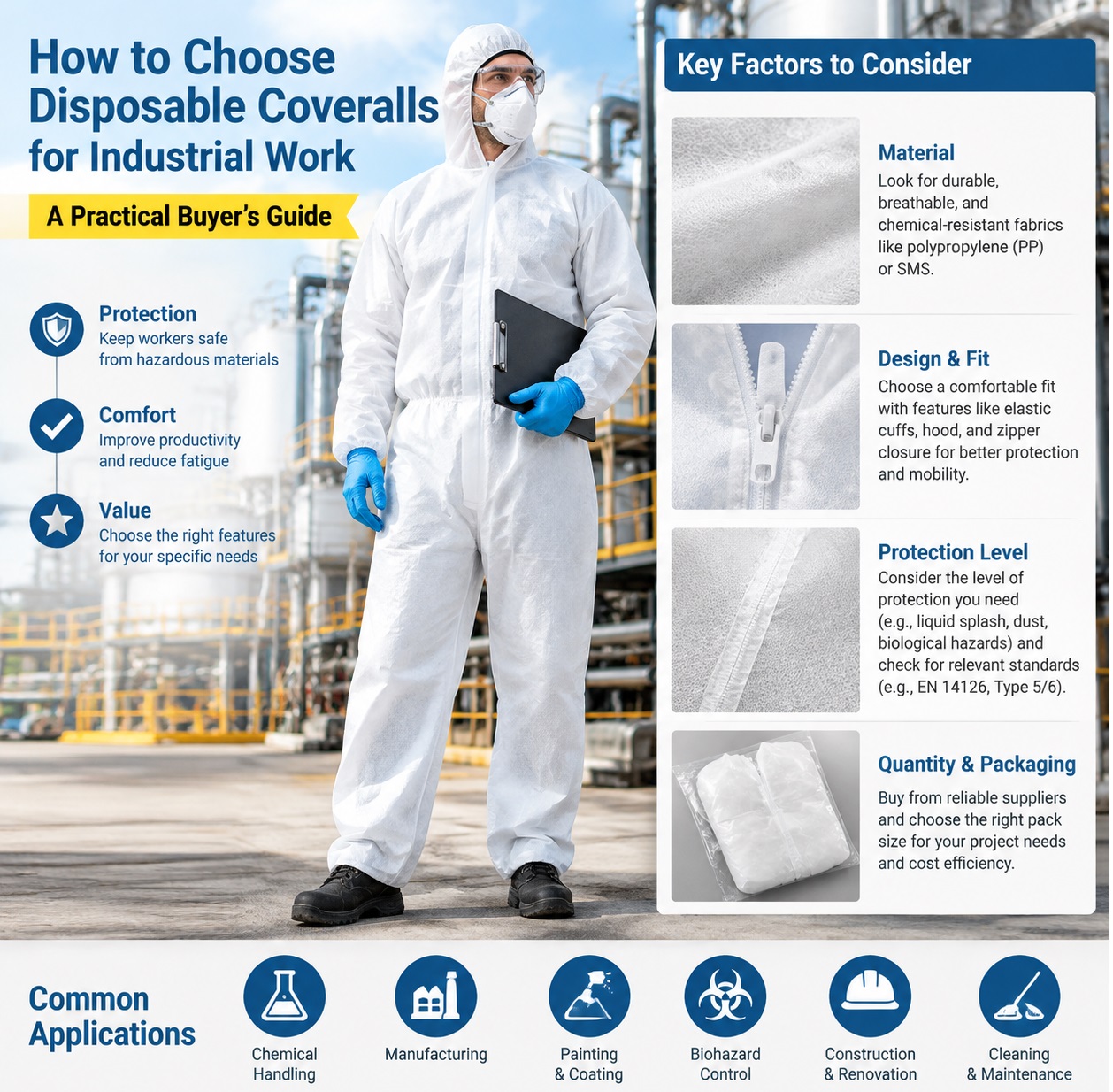 If your idea of specifying a disposable coverall is picking the cheapest white suit on a website, you are one ripped seam away from a very expensive safety incident. Industrial coveralls are not fashion. They are a barrier. The wrong one either fails when it matters or gets so hot that workers tear it off in the first hour. Both outcomes cost more than the suit.
So let us talk like buyers, not catalog browsers. Here is how to choose disposable coveralls without wasting money, over-specifying, or gambling with worker safety.
THE HAZARD COMES FIRST
Do not start with fabric weight, color, or price. Start with what the worker is actually facing. Dry dust from sanding, cement, or powders? Light liquid splash from oils, solvents, or paint? A spray of chemicals? A pressurized jet? Each exposure route demands a different level of protection.
For dry particles, you are usually looking at a Type 5 coverall. For limited liquid splash, Type 6 is common. If you need spray-tight protection, Type 4. Liquid-tight chemical protection moves into Type 3. If you do not know which type fits your job, stop and ask an industrial hygienist or a supplier with real technical support. Guessing here is not a shortcut. It is a liability.
FABRIC IS NOT A DETAIL
Disposable coveralls are made from different materials, and they behave very differently. Basic polypropylene is cheap and breathable but offers limited barrier. SMS fabric, made of spunbond and meltblown layers, gives better particle protection and still breathes reasonably well. Microporous film laminated to a nonwoven backing improves liquid splash resistance, but it can feel like wearing a plastic bag. Flashspun HDPE, often known by the brand name Tyvek, is strong, low-linting, and good for dry particles, though it is not a chemical splash suit.
The trick is matching the fabric to the exposure. A painter dealing with overspray does not need the same coverall as a maintenance tech changing dry filters. A worker handling fine powders needs different seams than someone wiping down equipment with solvents. If a supplier cannot explain the fabric in plain language, that is a warning sign.
SEAMS ARE WHERE CHEAP SUITS FAIL
You can have great fabric and still get a bad coverall if the seams are weak. Serged seams are common and fine for dry particle protection. Bound seams are stronger and reduce fraying. Taped seams give the best liquid and chemical resistance because they seal the stitch holes. If your hazard involves liquids, sprays, or chemicals, taped seams are not an upgrade. They are the point.
Also check the zipper. A flimsy zipper with no storm flap is a weak spot. A covered zipper with a flap, and ideally a taped flap for liquid protection, keeps the barrier intact. Elastic at the hood, wrists, and ankles helps close gaps. Thumb loops can keep sleeves in place during overhead work, but they are a nice-to-have, not a replacement for proper sizing.
CERTIFICATIONS TELL YOU WHAT THE SUIT CAN DO
Do not trust a product photo that says “chemical protective.” Look for actual standards. In Europe, Type 5 and Type 6 coveralls should be tested to EN ISO 13982-1 and EN 13034. Type 4 and Type 3 fall under EN 14605. Type 1 and Type 2 under EN 943. CE Category III is a minimum signal for chemical protection, but the CE mark alone is not enough. Ask for the EU type examination certificate, test reports, and the notified body number.
In the US, look for relevant ASTM tests and clear documentation. If the seller cannot produce test reports, walk away. Safety gear is not the place to trust a vague claim. “Heavy duty” and “industrial grade” mean nothing without numbers.
FIT IS A SAFETY FEATURE
A coverall that is too small will split at the crotch or shoulders. One that is too big will snag on machinery, catch on door handles, or trip the wearer. Neither is acceptable. Get a real size chart. Measure chest, height, and weight. If the coverall is worn over street clothes or FR clothing, size up. Then test it.
Order samples. Have workers squat, reach overhead, bend, and climb a ladder. Check whether the hood stays up, the sleeves stay down, and the legs do not drag. If the coverall restricts movement, workers will avoid wearing it correctly. If it is too loose, it becomes a hazard. The best disposable coverall is the one that disappears on the body and lets the worker focus on the job.
COMFORT AND HEAT STRESS
Industrial work is often hot. A coverall with excellent barrier properties can still fail if the worker overheats and unzips it. Breathability matters, especially in dry, particle-heavy tasks. SMS fabrics usually breathe better than microporous films. In hot environments, plan work and rest cycles, provide water, and consider cooling measures. Do not solve a heat problem by choosing a coverall that cannot handle the hazard. Solve it with the right fabric, the right fit, and better work practices.
COST PER USE, NOT PRICE PER SUIT
The cheapest coverall is rarely the cheapest option. One failed seam can mean a chemical burn, a contaminated worker, or a shutdown. One uncomfortable suit can mean low compliance and repeated replacement. Look at cost per use, not just the unit price. Factor in failure rates, size range, pack sizes, shelf life, and storage conditions.
Buying in bulk can lower the price, but only if you have the right suit. Stocking the wrong size or the wrong protection level is just expensive clutter. Keep coveralls away from UV light, moisture, and chemicals. Respect the shelf life. Old, degraded fabric is not protection.
THE SUPPLIER MATTERS AS MUCH AS THE SUIT
A good supplier will ask about your hazards before sending a quote. They will provide samples, size charts, test reports, and lot traceability. They will tell you what a coverall cannot do. They will help you compare Type 5, Type 6, and Type 4 options without pushing you into overkill. They will also keep consistent stock, because a safety program cannot run on backorders.
If a supplier leads with price only, keep shopping. If they cannot explain the difference between SMS and microporous film, keep shopping. If they promise “one suit fits every job,” run.
RED FLAGS TO AVOID
No test reports. Vague fabric weight. No size chart. No lot numbers. No samples. Claims like “chemical proof” without a type rating. A coverall that is somehow both fully breathable and liquid-tight. These are not minor details. They are signs that the product is being sold as a commodity instead of a safety barrier.
Choosing disposable coveralls for industrial work is not about finding the cheapest suit. It is about matching the barrier to the hazard, the fit to the worker, and the supply to the job. Get those three right, and the price conversation gets much easier. If you want help narrowing down the right Type 5, Type 6, or Type 4 coverall for your plant, talk to a supplier who asks questions first. Your workers will notice. Your safety record will too.